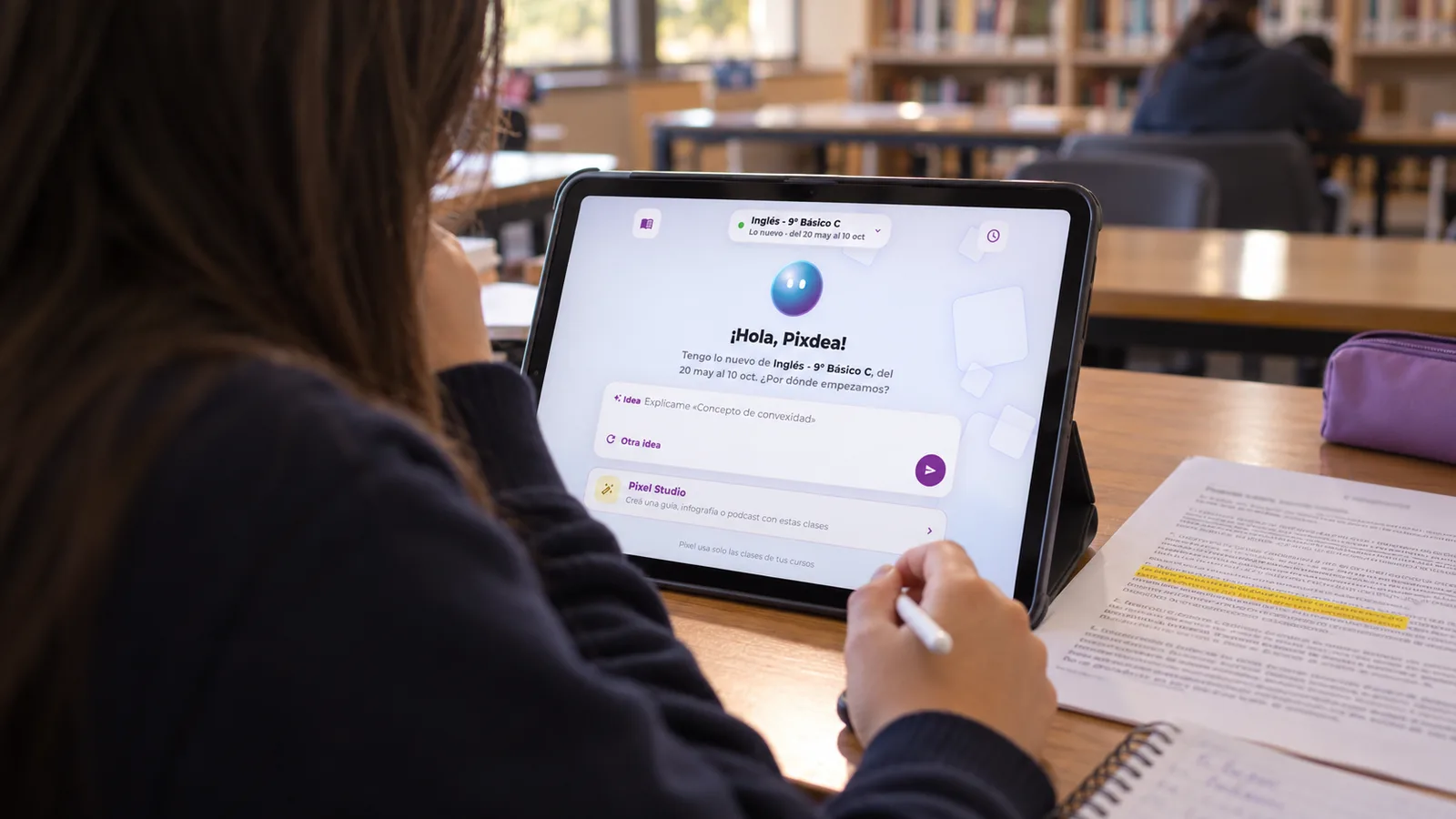
An AI tutor for students is an assistant that answers and guides from a reference material, for example the class a teacher actually taught. For it to be reliable, it is not enough that the text it retrieves covers the topic: it must contain the evidence that answers the question. An experiment I ran with language models shows that when that evidence is missing, the model keeps answering with confidence instead of flagging the gap.
Picture this. A student asks an AI tutor: “How are muscles attached to the skeleton?” The system searches the class notes, finds a paragraph about muscles and bones, and answers. The paragraph is relevant. But did it contain the word the student needed? If not, the tutor just answered with what it “knows”, not with what her teacher explained.
That gap between relevant and sufficient is the heart of this article. I studied it in an academic experiment with language models, and I am sharing what I learned because any school evaluating an AI tutor should be asking these same questions.
What does it mean for a text to be relevant but not sufficient?
A passage is relevant when it deals with the topic of the question. It is sufficient when it also contains the specific relationship or fact that answers it. Search engines and AI systems are very good at the first and do not guarantee the second.
A real example from the experiment, using a school biology text:
- Question: “Skeletal muscles are attached to the skeleton by tough connective tissues called what?”
- Original text: “Skeletal muscles are attached to the skeleton by tough connective tissues called tendons. Many skeletal muscles are attached to the ends of bones that meet at a joint…”
- Same text without the word “tendons”: it still talks about muscles, bones and joints. It is still relevant. It is no longer sufficient.
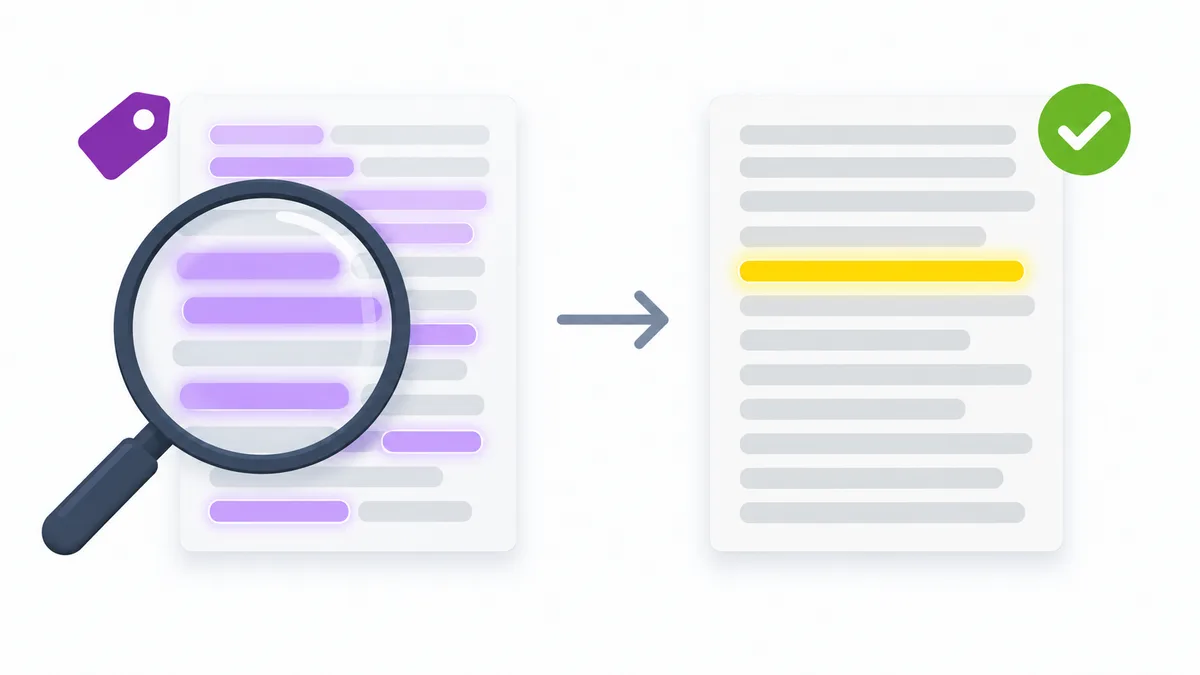
Relevant (left) is not the same as sufficient (right). AI-generated illustration.
In a real class this happens all the time: the teacher defines a concept in one sentence and develops it in the next ones. If the system retrieves only the next ones, the topic is there, but the definition is not.
The experiment: what I tested and how
This work was my assignment for the Deep Learning course INF3812 (October 2026), and I designed it with Pixel Tutor in mind, the PIXLAB Class tutor that guides each student with questions based on their real class. It is an academic experiment with public models, not a measurement of the product.
- Data: 100 science questions from the evaluation set of the public SciQ dataset, each with its supporting paragraph and reference answer.
- Models: a small model trained from scratch (a GRU recurrent network) and a public pretrained model (FLAN-T5-small), both given the question and the paragraph with the instruction to answer using only that text.
- Interventions: in 8 additional cases I prepared four versions of each paragraph and watched whether the answer changed.
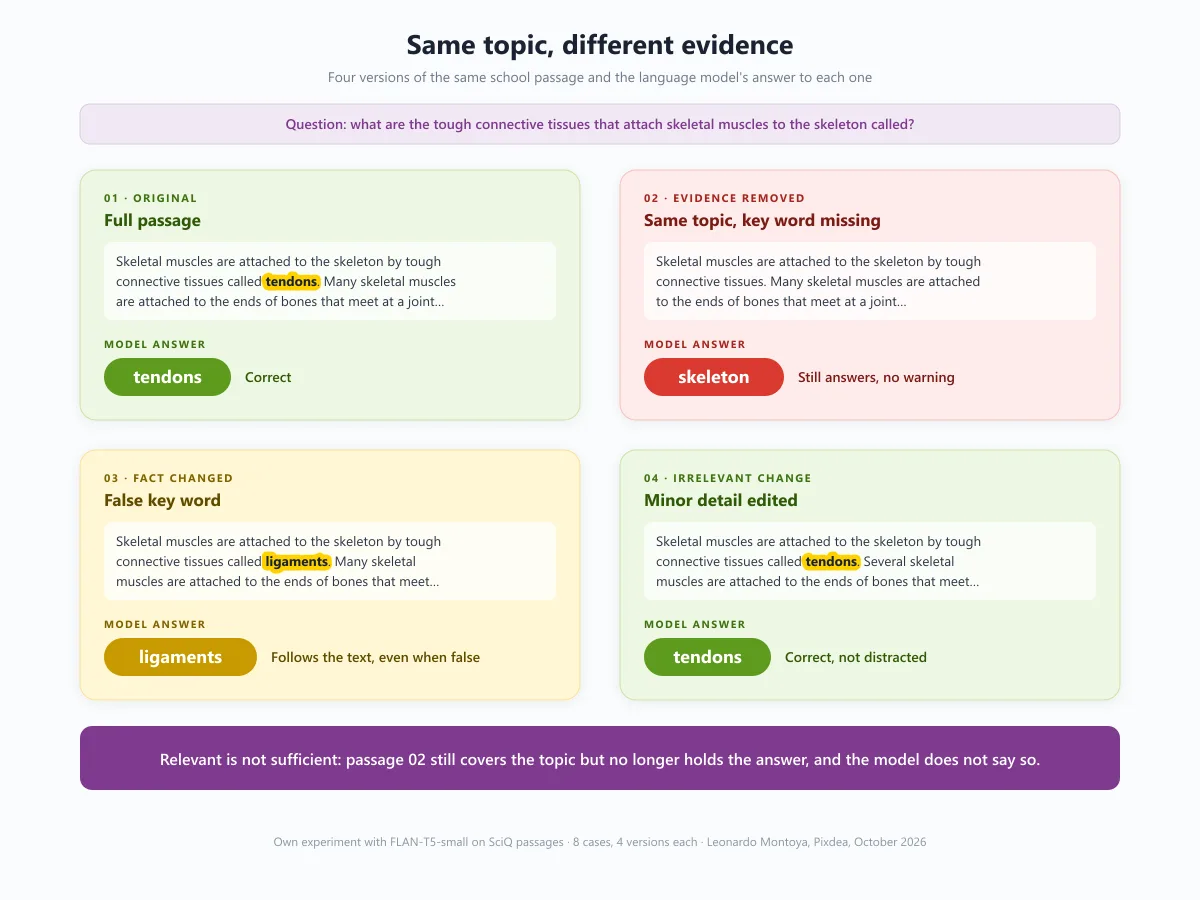
Real case from the experiment (SciQ, sciq-test-00093) with FLAN-T5-small. Own infographic.
| Passage version | What I changed | What I expected | What the pretrained model did |
|---|---|---|---|
| Original | Nothing | Correct answer | Got 8 out of 8 right |
| Evidence removed | Deleted the sentence that answers; the topic stays | A warning that information is missing | Changed its answer in 8 of 8, but still answered something |
| Fact changed | Replaced the key fact with a false one (e.g. “ligaments” instead of “tendons”) | Follow the text | Changed in 8 of 8 and repeated the false fact in 6 of 8 |
| Irrelevant change | Edited a minor detail | Same answer | Kept its answer in 8 of 8 |
In the tendons case, the model answered “tendons” with the original text, “ligaments” when I changed the fact, and “skeleton” when I removed the evidence. It never said “the text does not say”.
Three findings that matter to a school
1. The model follows the text you give it, even when it is false
When I replaced the correct fact with an invented one, the model adopted the invented fact. This is good news and a warning at the same time. Good, because a well-fed tutor sticks to what the teacher taught. A warning, because the quality of the knowledge base defines the quality of the answers. A transcript with errors or a badly cut passage turns into answers with errors.
2. When the evidence is missing, it does not say so
When I removed the decisive sentence, the model changed its answer in every case, but in none of them did it acknowledge that information was missing. It answered with the closest thing it found or with what it remembered from training. For a student preparing for an exam, a confident wrong answer is worse than “I did not find this in your class”.
3. Looking at “which part it read” is not enough
Language models have a mechanism called attention, which indicates which parts of the text they weigh most. I tried removing the sentence with the most attention in four cases: the answer changed in three. But in the fourth it stayed the same, because the definition was still available in another sentence. A sentence can receive a lot of attention and not be indispensable. The only reliable way to know whether a passage is enough is to check whether it contains the relationship that answers the question.
What should you ask an AI tutor vendor?
This is the list I would use if I were a school leader and someone pitched me any AI tutor, including ours:
- Where do the answers come from? The teacher’s real class, a generic textbook, or the model’s general knowledge.
- What happens when the answer is not in the material? Ask for a demo with a question the material does not cover. Watch whether it invents or says so.
- Can I see the passage it used? Traceability lets the teacher fix the material, not just the answer.
- Who reviews the source material? Transcripts, notes and summaries should pass through the teacher before feeding the tutor.
- Does the tutor give the answer or guide with questions? A Socratic tutor limits the damage of an error, because the student reasons instead of copying.
If you want to see how we answer these five questions, book a demo for your school.
How we apply this in Pixel Tutor
PIXLAB Class is an artificial intelligence ecosystem for schools made of three connected tools: PIXLAB Live supports the teacher in the classroom, PIXLAB Class Web turns every class into knowledge and feedback, and Pixel Tutor guides each student with questions based on their real class.
That last sentence is the reason for this experiment. Pixel Tutor does not answer from a generic textbook: it starts from the class transcript and summary that PIXLAB Class Web produces, and guides the student with questions so they reason. The work I describe here gave me a concrete way to review the passages that reach the tutor: it is not enough that they match the question, they must preserve the relationship that answers it.
The next step, which we are working on, is to apply these same tests to passages from real classes reviewed by teachers. I will share the results on this blog when I have them.
Limits of the experiment
I would rather state them myself before an attentive reader finds them:
- I used English science texts from a public dataset, not class transcripts.
- The small model I trained from scratch got only 2 of 100 questions right; its results support few conclusions. The findings come from the pretrained model, which got 68 of 100.
- The pretrained model saw this same dataset during its training, which may inflate its accuracy.
- The 8 intervention cases are few and related to each other: they describe a behavior, not a general rate.
- I handed the paragraphs over directly; I did not evaluate passage retrieval or the conversation with students.
None of this changes the practical conclusion: a text can keep talking about the topic and lose the evidence, and the model will not tell you on its own.
Key takeaways
- Relevant is not sufficient: a passage can cover the topic and not contain the answer.
- A language model follows the text it receives, even when the fact is false. The quality of the source material is everything.
- When evidence is missing, the model answers anyway instead of flagging it.
- Ask the vendor for a demo with a question the material does not cover.
- Pixel Tutor starts from the teacher’s real class and guides with questions; this experiment shapes how we review its passages.
Frequently asked questions
Can an AI tutor make up answers even when it has the class material?
Yes. If the passage it retrieves covers the topic but lacks the needed fact, the model tends to fill in with the closest thing or with its general knowledge, without warning. That is why the material must preserve the key definitions and relationships, not just the topic's vocabulary.
What is the difference between Pixel Tutor and asking ChatGPT?
Pixel Tutor starts from the teacher's real class, recorded and summarized by PIXLAB Class Web, and guides the student with questions instead of handing over the answer. ChatGPT answers from its general knowledge, with no connection to what was taught in the classroom or to the teacher's emphasis.
Do the results of this experiment measure Pixel Tutor's performance?
No. It is an academic experiment with public models and English science texts. Its contribution is a method to check whether a passage preserves the necessary evidence. We are working on applying it to passages from real classes reviewed by teachers.
What can a school do today to reduce this risk?
Three things: require that the tutor answers from the school's own material, ask for a demo with a question the material does not cover, and make sure a teacher reviews transcripts and summaries before they reach students.
Sources
- Welbl, J., Liu, N. F., Gardner, M. Crowdsourcing Multiple Choice Science Questions. 2017.
- Allen Institute for AI. SciQ dataset (description and license).
- Google. FLAN-T5-small model card.
- Hewitt, J., Liang, P. Designing and Interpreting Probes with Control Tasks. 2019.
- Montoya, L. Assignment 2, course INF3812 Deep Learning: "Related topic and sufficient evidence · Pixel Tutor". Author's notebook and results, October 2026.
- Pixdea. PIXLAB Class official site. 2026.